
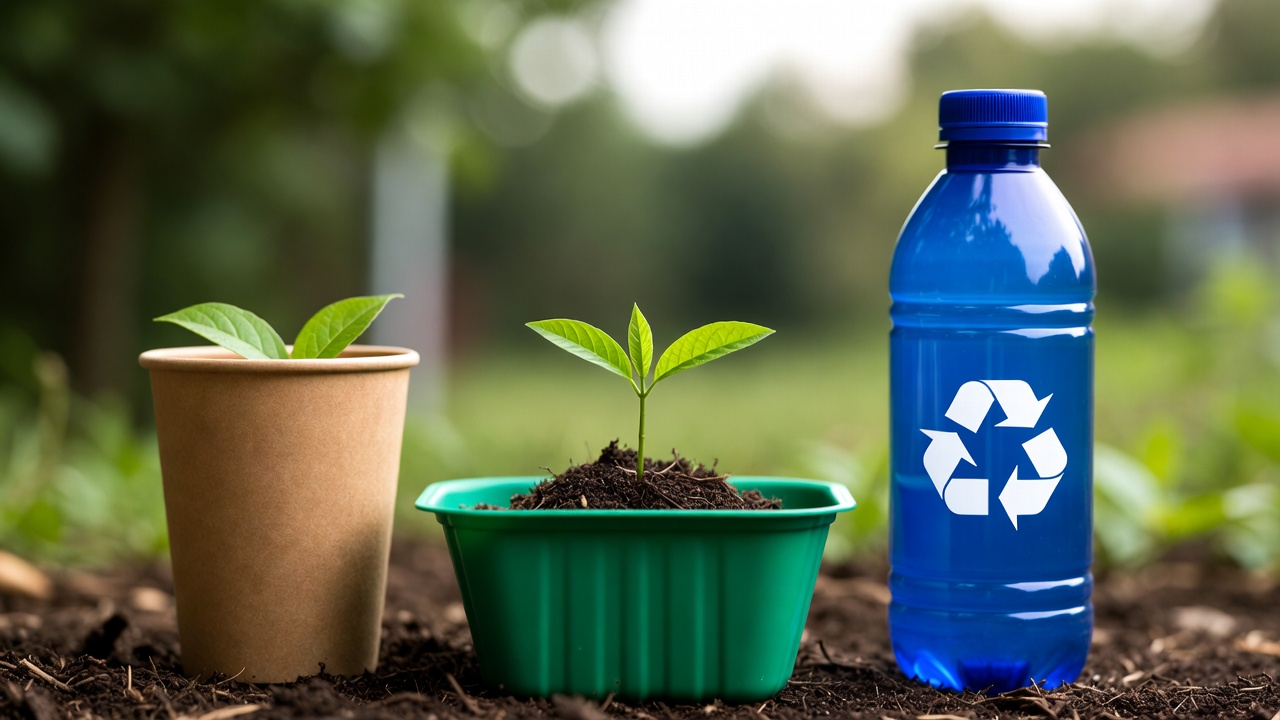

A Complete Industry Guide to Understanding Material End-of-Life Pathways, Certifications, and What They Actually Mean for the Planet
The packaging world is drowning in green terminology. Walk through any grocery store or browse any e-commerce site, and you will encounter products labeled “biodegradable,” “compostable,” “recyclable,” “eco-friendly,” “plant-based,” or “degradable” — often used loosely, sometimes interchangeably, and frequently in ways that mislead more than they inform.
For businesses sourcing sustainable packaging and for consumers trying to make responsible choices, this confusion is not just inconvenient — it has real environmental consequences. A compostable bag thrown into a recycling bin contaminates the entire batch. A “biodegradable” product sent to a landfill may persist for decades. A recyclable container placed in a compost pile will never break down.
Understanding the precise differences between compostable, biodegradable, and recyclable is not a matter of semantics. It is the foundation of effective waste management and genuine environmental progress.
This guide goes beyond surface-level definitions. We will examine the science behind each term, the international certification standards that govern them, the regulatory landscape shaping their use, the common misconceptions that lead to greenwashing, and the practical decision-making framework that businesses and consumers need to dispose of materials correctly.
The Three Pathways: A Fundamental Distinction
Before diving into details, it helps to understand that compostable, biodegradable, and recyclable describe three fundamentally different end-of-life pathways for a material. They answer different questions:
- Recyclable asks: Can this material be reprocessed into new raw material for manufacturing?
- Biodegradable asks: Will this material break down through biological processes?
- Compostable asks: Will this material break down under specific conditions, within a defined timeframe, into non-toxic compost that benefits the soil?
These are not rankings on a single scale. They are separate categories with different requirements, different infrastructure dependencies, and different environmental outcomes. A product can be one, two, or none of these — and being one does not automatically make it another.
Recyclable: Extending Material Life Through Reprocessing
What It Actually Means
Recycling is the process of collecting used materials, breaking them down to their base components, and remanufacturing them into new products. The goal is to keep materials in the economic loop for as long as possible, reducing the demand for virgin raw materials and diverting waste from landfills.
Unlike composting or biodegradation, recycling does not allow a material to return to nature. Instead, it gives the material a second (or third, or fourth) life as a manufactured product.
Common Recyclable Materials
Recyclable materials in the packaging world typically include glass, metals (aluminum, steel, tin), certain plastics (primarily PET #1 and HDPE #2), paper, and cardboard. Each material has its own recycling stream, its own contamination risks, and its own limitations on how many times it can be reprocessed.
The Nuance Most People Miss
Just because a material is technically recyclable does not mean it will be recycled. Recycling depends entirely on local infrastructure, sorting technology, market demand for recycled materials, and consumer behavior. A perfectly recyclable PET bottle is worthless if the local municipality has no curbside collection, or if it is contaminated with food residue, or if the global market for recycled PET has collapsed.
This is the critical gap between “recyclable” as a material property and “recycled” as an actual outcome. According to widely cited industry data, the global recycling rate for plastics remains below 10%. Paper and cardboard perform better, but contamination — particularly from food waste and mixed materials — remains a persistent challenge.
Limitations of Recycling
Several important limitations define the practical boundaries of recycling:
Downcycling. Many materials degrade in quality each time they are recycled. Paper fibers shorten with each reprocessing cycle, eventually becoming too weak to form new paper. Most plastics can only be recycled once or twice before the polymer chains become too degraded, at which point the material is either landfilled or incinerated.
Contamination sensitivity. Recycling systems are highly sensitive to contamination. A single food-soiled pizza box can compromise an entire batch of paper recycling. Compostable packaging mistakenly placed in recycling bins can contaminate plastic streams because compostable polymers (like PLA) have different melting points and chemical structures than conventional plastics.
Multi-material complexity. Products made from multiple bonded materials — such as a paper cup with a plastic lining, or a foil-lined snack pouch — are extremely difficult or impossible to recycle because the materials cannot be separated economically.
Infrastructure dependency. Recycling rates vary dramatically by region. A product that is easily recycled in Germany or Japan may have no viable recycling pathway in many parts of Africa, Southeast Asia, or rural North America.
Biodegradable: The Most Misunderstood Term in Sustainability
What It Actually Means
Biodegradable means that a material can be broken down by naturally occurring microorganisms — bacteria, fungi, algae — into simpler substances such as water, carbon dioxide, methane, and biomass. In the strictest scientific sense, virtually every organic material on earth is biodegradable, given enough time.
And that is precisely the problem with this term.
Why “Biodegradable” Is Problematic
Unlike “compostable,” the term “biodegradable” has no universally enforced standard, no mandated timeframe, and no required testing protocol. A product can technically be called biodegradable even if it takes 500 years to break down. A plastic bag made from conventional polyethylene will eventually biodegrade — in perhaps a few hundred years — but no reasonable person would consider that a sustainable outcome.
This lack of precision has made “biodegradable” one of the most abused terms in environmental marketing. Some key issues include:
No timeframe requirement. Without a certified composting standard, there is no legal obligation to specify how long biodegradation will take. A product labeled “biodegradable” might break down in six months or six centuries.
No condition specification. Biodegradation rates depend heavily on environmental conditions — temperature, moisture, oxygen levels, microbial populations. A product that biodegrades in a tropical compost heap may persist indefinitely in a dry landfill where oxygen and moisture are scarce.
Microplastic risk. Many products marketed as “biodegradable” fragment into smaller and smaller pieces — including microplastics — before fully decomposing. This fragmentation does not equal biodegradation. Microplastics can persist in soil and water, enter the food chain, and cause ecological harm that is only beginning to be understood.
No composting benefit. Unlike certified compostable materials, biodegradable products are not required to produce useful compost, pass ecotoxicity tests, or demonstrate that the end product is safe for soil and plant growth.
Regulatory Crackdowns on “Biodegradable” Claims
Recognizing the potential for consumer deception, multiple jurisdictions have restricted or banned the use of “biodegradable” as a marketing term for packaging:
- California (United States): State law prohibits the use of “biodegradable,” “degradable,” or “decomposable” on any plastic product sold in the state unless the product meets ASTM D6400 compostability standards.
- Washington State (United States): No product can be labeled “biodegradable,” “degradable,” “decomposable,” or any similar term. The only permitted environmental claim is “compostable,” and only if the product carries third-party certification.
- European Union: The EU’s Green Claims Directive is tightening rules around environmental marketing terms, requiring substantiation for any biodegradability claim.
- Australia: The ACCC (Australian Competition and Consumer Commission) has taken enforcement action against misleading “biodegradable” claims on products that do not break down in real-world disposal conditions.
The trend is clear: regulators worldwide are moving away from accepting vague “biodegradable” claims and demanding the specificity and accountability that compostability certifications provide.
Oxo-Degradable: A Special Warning
Oxo-degradable (or oxo-biodegradable) plastics deserve special mention because they represent perhaps the most misleading category of all. These are conventional petroleum-based plastics with chemical additives that cause the material to fragment into small pieces when exposed to UV light or heat.
Critically, oxo-degradable plastics do not biodegrade in any meaningful timeframe. They simply break into microplastics faster. The European Union has banned oxo-degradable plastics under the Single-Use Plastics Directive (SUPD), and they are excluded from all recognized composting standards including EN 13432, ASTM D6400, and Australian AS 4736.
If a product is labeled “oxo-degradable” or “oxo-biodegradable,” it is neither compostable nor genuinely biodegradable. It should be treated as conventional plastic waste.
Compostable: The Gold Standard, With Conditions
What It Actually Means
A compostable material is one that breaks down through biological processes into water, carbon dioxide, inorganic compounds, and biomass — at a rate consistent with other known compostable materials — leaving no toxic residue and producing a final compost product that is safe and beneficial for soil and plant growth.
The key distinction from “biodegradable” is that compostability is defined by strict, measurable, third-party-verified standards. The claim is not vague — it specifies what the material breaks down into, how quickly it must do so, and what safety tests the end product must pass.
The Science: What Happens During Composting
Composting is a managed aerobic biological process. In an industrial composting facility, conditions are controlled to optimize microbial activity:
- Temperature: Maintained at thermophilic levels (55–70°C / 131–158°F) to accelerate microbial breakdown and kill pathogens.
- Moisture: Kept at approximately 50–60% to support microorganism activity.
- Oxygen: Regular turning or aeration ensures aerobic conditions, preventing the anaerobic decomposition that produces methane.
- Carbon-to-nitrogen ratio: Balanced (typically around 25:1 to 30:1) to provide optimal nutrient availability for microbial populations.
Under these conditions, certified compostable materials break down alongside food waste, yard trimmings, and other organic matter, becoming indistinguishable from the surrounding compost within the timeframe defined by the relevant standard.
Industrial Composting vs. Home Composting
Not all composting is the same, and this is one of the most critical distinctions consumers and businesses need to understand.
Industrial (commercial) composting takes place in large-scale facilities where temperature, moisture, and aeration are actively managed. The sustained high temperatures (above 55°C for extended periods) are essential for breaking down materials like PLA (polylactic acid), which requires hydrolysis triggered by heat before microorganisms can consume the polymer. Most certified compostable packaging is designed for industrial composting conditions.
Home composting occurs in backyard compost bins or piles where temperatures are lower (typically 20–45°C), conditions fluctuate with the seasons, and the process is far less controlled. Not all industrially compostable products will break down in a home compost environment. Only products specifically certified for home composting — such as those carrying the TUV Austria “OK Compost HOME” mark or meeting the Australian AS 5810 standard — can reliably be home composted.
This distinction matters enormously. If a product is certified compostable only under industrial conditions (EN 13432, ASTM D6400) and is placed in a home compost bin, it may persist for years, frustrating the user and undermining trust in compostable products generally.
International Compostability Standards: A Technical Comparison
One of the areas where existing articles fall short is in providing a clear, side-by-side technical comparison of the world’s major compostability standards. Here is what each actually requires:
ASTM D6400 (United States / North America)
- Scope: Plastics designed to be aerobically composted in municipal or industrial facilities.
- Biodegradation: ≥90% conversion of carbon to CO₂ within 180 days, tested under controlled composting conditions at thermophilic temperatures (58°C ± 2°C) per ASTM D5338.
- Disintegration: ≤10% of material remaining on a 2 mm sieve after 84 days of composting per ISO 16929.
- Ecotoxicity: Resulting compost must support seed germination and plant growth at rates ≥90% of the control (using standardized plant growth tests).
- Heavy metals: Concentrations must remain below defined thresholds (based on regulated limits for zinc, copper, nickel, cadmium, lead, mercury, chromium, molybdenum, selenium, and arsenic).
- Certification body: Biodegradable Products Institute (BPI) is the primary third-party certifier in North America.
EN 13432 (European Union)
- Scope: Packaging and packaging materials recoverable through composting and biodegradation.
- Biodegradation: ≥90% conversion to CO₂ within 6 months (180 days) under controlled composting conditions.
- Disintegration: ≤10% of original dry weight remaining on a 2 mm sieve after 12 weeks of composting.
- Ecotoxicity: No adverse effect on composting process or compost quality; plant germination tests required.
- Heavy metals: Must not exceed thresholds defined in the standard (aligned with EU packaging waste directive limits).
- Chemical composition: Volatile solids, heavy metals, fluorine, nitrogen, phosphorus, magnesium, and potassium must be within specified limits.
- Certification bodies: TUV Austria (OK Compost), DIN CERTCO (Germany).
- Legal significance: EN 13432 certification is legally required to market packaging as “compostable” in the EU under the Packaging and Packaging Waste Directive (94/62/EC).
AS 4736 (Australia — Industrial Composting)
- Scope: Biodegradable plastics suitable for composting and other microbial treatment.
- Biodegradation: ≥90% absolute or ≥90% relative to reference material within 180 days.
- Disintegration: ≤10% remaining on 2 mm sieve after 12 weeks.
- Ecotoxicity and heavy metals: Similar thresholds to EN 13432.
- Certification body: Australasian Bioplastics Association (ABA).
AS 5810 (Australia — Home Composting)
- Scope: Biodegradable plastics suitable for home composting.
- Biodegradation: ≥90% within 12 months at ambient temperature (no active temperature management).
- Disintegration: ≤10% remaining on 2 mm sieve after 6 months.
- Key difference from AS 4736: Testing occurs at lower, ambient temperatures that simulate home composting conditions rather than controlled industrial temperatures.
TUV Austria OK Compost HOME
- Scope: Materials suitable for home composting across Europe.
- Biodegradation: ≥90% within 12 months at ambient temperature (20–30°C).
- Disintegration: ≥90% within 6 months.
- Widely recognized as the de facto European standard for home compostability.
What These Standards Have in Common
Despite regional differences, all major compostability standards share the same four pillars of testing:
- Biodegradation — The material must convert to CO₂ at a rate and extent comparable to natural organic matter.
- Disintegration — The material must physically break apart into small fragments that are not visible in the finished compost.
- Ecotoxicity — The resulting compost must be safe for the environment, supporting healthy plant growth.
- Heavy metal safety — The material must not introduce harmful concentrations of regulated heavy metals into the compost.
Any claim of “compostability” that is not backed by third-party certification against one of these standards should be treated with skepticism.
The Greenwashing Problem: Terms to Watch Out For
The gap between what consumers understand and what environmental labels actually mean creates fertile ground for greenwashing. Here are terms that frequently mislead:
“Degradable” — This means almost nothing. All materials are technically degradable given enough time. Unlike “compostable,” this term carries no certification, no timeframe, and no environmental safety requirement. It is often used on conventional plastics with pro-degradant additives (oxo-degradable), which are now banned in the EU.
“Bio-based” — This indicates that a product is derived from plant material rather than petroleum. However, bio-based does not mean biodegradable or compostable. A bio-based plastic can be chemically identical to petroleum-based plastic and persist in the environment for the same duration. Bio-based PET (used in some beverage bottles) is recyclable in the PET stream but is not compostable.
“Plant-based” — Similar to bio-based, this describes the origin of the raw material, not its end-of-life behavior. A plant-based product may or may not be compostable. Always check for third-party compostability certification.
“Eco-friendly” / “Green” / “Earth-friendly” — These are subjective marketing terms with no standardized definition or certification process. They should not be relied upon as indicators of compostability, recyclability, or any specific environmental attribute.
“Made from recycled materials” — This describes the input, not the output. A product made from recycled plastic is still plastic. It may or may not be recyclable again, and it is almost certainly not compostable.
Side-by-Side Comparison
| Attribute | Recyclable | Biodegradable | Compostable |
|---|---|---|---|
| Core process | Material reprocessed into new products | Microorganisms break material down | Controlled biological decomposition into safe compost |
| Timeframe defined? | N/A | No standardized timeframe | Yes — typically 90–180 days (industrial) or 6–12 months (home) |
| Third-party certification required? | Varies by material and region | No universal certification | Yes — BPI, TUV, DIN CERTCO, ABA, etc. |
| Returns nutrients to soil? | No | Not guaranteed | Yes — ecotoxicity and plant growth tests required |
| Heavy metal testing? | No | No | Yes |
| Regulated marketing term? | Generally yes (in many jurisdictions) | Banned or restricted in several regions | Strictly regulated in EU, US states, Australia |
| Microplastic risk? | Low (if properly recycled) | High (fragmentation without full degradation) | Low (full disintegration required) |
| Infrastructure required | Recycling facilities and sorting systems | Varies (often no specific infrastructure) | Industrial or home composting systems |
| Can contaminate other waste streams? | Yes (if mixed with organics) | Yes (if mixed with recycling or compost) | Yes (if placed in recycling bins) |
| Relationship | Separate pathway | All compostable items are biodegradable | Subset of biodegradable, with strict standards |
Making the Right Choice: A Decision Framework
For businesses selecting packaging materials or consumers deciding how to dispose of a product, here is a practical framework:
For Businesses Choosing Packaging
Step 1: Define the use case. What does the packaging contain? Food-contact applications (where contamination is likely) favor compostable materials because food-soiled packaging often cannot be recycled. Dry goods with clean packaging may be better served by recyclable materials.
Step 2: Understand your customer’s disposal infrastructure. If your primary market has widespread access to industrial composting (parts of California, the Pacific Northwest, much of Western Europe), certified compostable packaging is a strong choice. If composting infrastructure is limited but recycling systems are robust, recyclable materials may achieve better real-world environmental outcomes.
Step 3: Demand certified claims. Never accept “biodegradable” without a specific standard attached. Require BPI, TUV Austria, or DIN CERTCO certification for any compostability claim. Request test reports and certificate numbers.
Step 4: Communicate clearly to end users. The best material choice is wasted if the consumer does not know how to dispose of it. Include clear disposal instructions, certification logos, and color coding (green/brown/beige for compostable as per Washington State and other regulatory guidelines) on every product.
For Consumers Disposing of Products
Step 1: Look for certification logos. BPI, TUV OK Compost, DIN CERTCO seedling logo, or ABA logo are reliable indicators of genuine compostability.
Step 2: Check your local composting program. Not all composting facilities accept all compostable products. Some accept only food waste and yard trimmings. Check with your local waste hauler.
Step 3: Never put compostable products in recycling bins. Compostable polymers like PLA will contaminate conventional plastic recycling streams.
Step 4: Never put recyclable products in compost bins. Conventional plastics, metals, and glass will not break down and will contaminate the compost.
Step 5: Be skeptical of vague claims. If a product says “biodegradable” or “eco-friendly” without a recognized certification logo, treat it as conventional waste and dispose of it accordingly.
The Bigger Picture: Why This Matters
The environmental impact of packaging waste is not determined by what a label says — it is determined by what actually happens to the material after the consumer is done with it. The best compostable product in the world achieves nothing if it ends up in a landfill. The most recyclable material fails its promise if it is contaminated and sent to incineration.
The real solution is not choosing between compostable, biodegradable, and recyclable as if one is universally superior. It is about matching the right material to the right application and the right end-of-life infrastructure — and then communicating clearly enough that the material actually reaches its intended destination.
At Pure Compostables, we believe that certified compostable products represent the most transparent, scientifically rigorous, and environmentally accountable option available today for food-contact packaging and single-use applications. Our products are certified to ASTM D6400, EN 13432, TUV Austria OK Compost (Industrial and Home), AS 4736, and AS 5810 — ensuring they meet the strictest standards in every major market.
But certification is only the beginning. We are equally committed to educating businesses and consumers on proper disposal practices, because we know that even the best compostable product only fulfills its environmental promise when it reaches a composting facility.
The future of sustainable packaging is not about green labels. It is about green outcomes.
Have questions about compostable packaging standards, certifications, or choosing the right products for your business? Contact our team — we are here to help.
For more industry insights, visit our Blog or explore our full range of certified compostable products.
Leave a Reply