
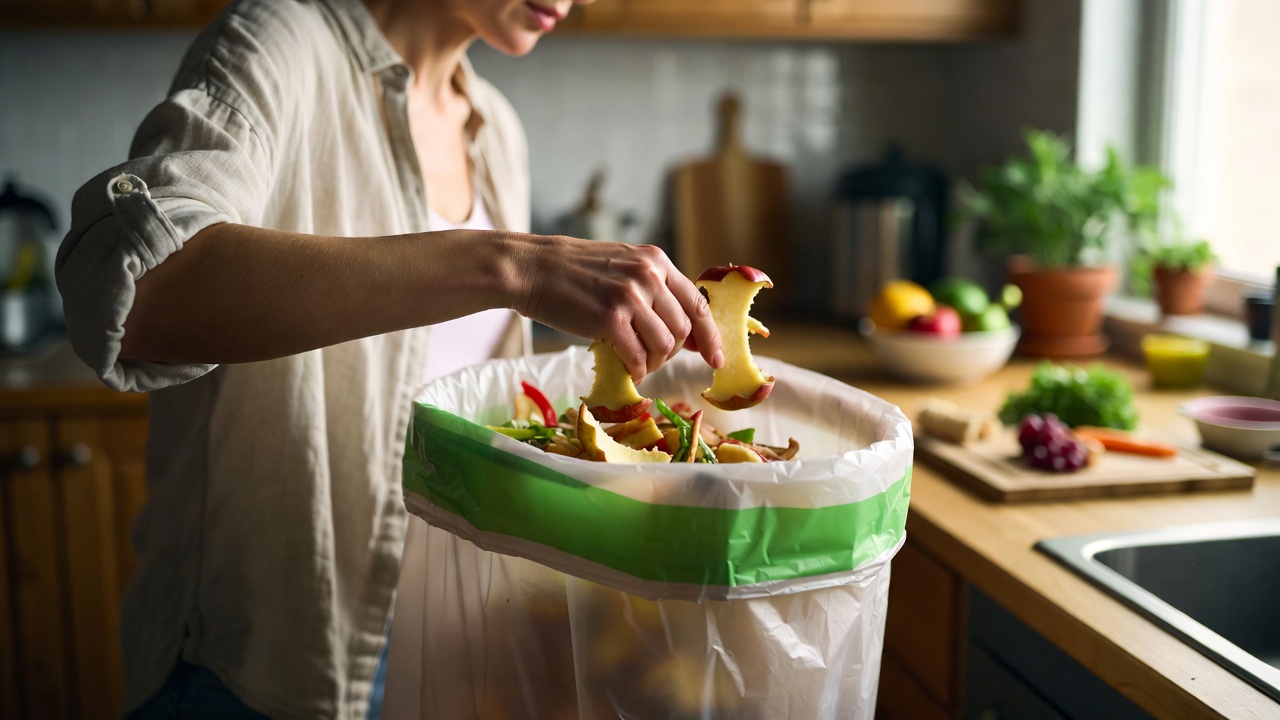

The Complete Guide to Matching Bag Capacity, Dimensions, and Thickness to Your Bin, Waste Type, and Composting System
Choosing the wrong trash bag size is a minor annoyance with conventional plastic bags. With compostable trash bags, it becomes a much bigger problem.
A compostable bag that is too small for the bin will slip, tear under load, and leak — and because compostable resins are engineered to break down, they are less forgiving of overfilling and stress than petroleum-based plastics. A compostable bag that is too large wastes material, increases cost per use, and creates excess film that can bunch up inside the bin, trapping moisture and accelerating premature degradation before the bag even reaches the compost facility.
Getting the size right is not just about convenience. It is about performance, cost efficiency, shelf life, and ensuring the bag actually fulfills its environmental purpose by arriving intact at the composting facility.
This guide covers everything you need to know — from how to measure your bin, to understanding the relationship between bag dimensions, thickness, and waste type, to navigating the differences between regional bin standards in North America, Europe, and Australia. Whether you are a homeowner buying retail packs or a procurement manager sourcing bulk liners for a municipal composting program, this is the most complete compostable trash bag sizing resource available.
Why Size Matters More for Compostable Bags
Before we get into specific sizes, it is important to understand why getting the fit right matters more for compostable bags than for conventional plastic.
Compostable bags are made from plant-based resins — typically blends of PLA (polylactic acid) and PBAT (polybutylene adipate terephthalate), often combined with corn starch or other bio-based polymers. These materials are engineered to biodegrade under composting conditions, which means they are inherently more sensitive to moisture, heat, and mechanical stress than conventional polyethylene.
Overfilling causes failure faster. Conventional LDPE (low-density polyethylene) bags can stretch significantly before tearing. Compostable resins have lower elongation at break — they tear rather than stretch. An overfilled compostable bag is far more likely to split at the seam or puncture at a stress point than an overfilled plastic bag of similar thickness.
Wet waste is the primary enemy. Compostable trash bags are most commonly used for food scraps, kitchen waste, and organic material — all of which are heavy, wet, and acidic. A bag that fits too tightly against the bin wall has no room for the weight to distribute, concentrating stress at the bottom seal. A properly sized bag with 2–3 inches of overhang above the bin rim allows you to tie the bag securely and lift it out without the bottom bearing excessive load.
Premature degradation is real. If a bag is too large and bunches up at the bottom of the bin, it creates pockets where moisture and warmth accumulate. In warm kitchens or during summer months, this microenvironment can trigger early hydrolysis of the PLA component, weakening the bag before it is even full. A snug (but not tight) fit keeps the bag extended and ventilated against the bin wall.
Step 1: Measure Your Bin Correctly
The most common mistake in choosing a trash bag size is relying on the bin’s stated gallon capacity without checking the actual dimensions. Two bins labeled “13 gallon” by different manufacturers can have significantly different heights, widths, and shapes — and may require different bag dimensions for a proper fit.
How to Measure a Round Bin
For a round (cylindrical) trash can, you need two measurements:
Diameter: Measure straight across the top opening of the bin at its widest point. This is the diameter.
Height: Measure from the bottom of the inside of the bin to the top rim.
To calculate the minimum bag width you need, use this formula: Bag width = (Diameter × 3.14) ÷ 2. This gives you the half-circumference, which is the flat width of a bag that will wrap around the inside of the bin.
To calculate the minimum bag height: Bag height = Bin height + (Diameter ÷ 2) + 3 inches. The extra dimension accounts for the bag folding across the bottom of the bin, plus 2–3 inches of overhang to drape over the rim and secure the bag in place.
How to Measure a Rectangular or Square Bin
For rectangular bins, measure the width, depth, and height of the interior.
Bag width = Width + Depth + 2 inches (to allow a small amount of slack).
Bag height = Bin height + Depth + 3 inches (to cover the bottom fold and rim overhang).
The Overhang Rule
For compostable bags, always choose a bag with at least 2–3 inches of overhang above the rim. This serves three purposes: it prevents the bag from slipping into the bin when you add waste, it provides enough material to tie the bag closed before removal, and it reduces the stress on the bottom seal when you lift the bag out. Some buyers prefer 4+ inches of overhang for heavy wet waste, especially in commercial food service settings.
Step 2: Understand Standard Bag Sizes
Compostable trash bags are manufactured in standard sizes that correspond to common bin capacities. However, because bins vary by region, it is important to understand both the gallon/liter capacity and the actual bag dimensions.
Complete Size Reference Table
| Common Name | Capacity (Gallons) | Capacity (Liters) | Typical Bag Dimensions (W × H) | Common Bin Type | Primary Use |
|---|---|---|---|---|---|
| Small / Countertop | 2–3 gal | 7–12 L | 17 × 18 in (43 × 46 cm) | Kitchen countertop compost caddy | Food scraps collection |
| Small Bathroom | 4 gal | 15 L | 17 × 20 in (43 × 51 cm) | Bathroom, office desk bin | Light dry waste |
| Medium | 8 gal | 30 L | 22 × 25 in (56 × 64 cm) | Under-sink, small kitchen bin | Mixed kitchen waste |
| Tall Kitchen (Standard) | 13 gal | 49–50 L | 24 × 30 in (61 × 76 cm) | Standard US kitchen trash can | General kitchen waste, food scraps |
| Large Kitchen / Office | 20 gal | 75 L | 30 × 33 in (76 × 84 cm) | Large kitchen bin, office | High-volume household or light commercial |
| Large | 33 gal | 125 L | 33 × 39 in (84 × 99 cm) | Outdoor bin, yard waste | Yard trimmings, event waste, lawn & leaf |
| Extra Large | 45 gal | 170 L | 40 × 46 in (102 × 117 cm) | Commercial bins, restaurant back-of-house | Commercial food service |
| Toter / Curbside | 64 gal | 240 L | 50 × 60 in (127 × 152 cm) | Curbside wheeled bin (toter) | Municipal curbside organics collection |
| Commercial Drum | 95 gal | 360 L | 56 × 68 in (142 × 173 cm) | Large commercial drum | Event waste, facilities management |
Important: These dimensions are general industry standards. Always check the specific product dimensions before purchasing, as manufacturers may vary by 1–2 inches in either direction.
Regional Bin Standards: Why It Matters
Bin sizes are not universal. The standard kitchen trash can in different markets varies significantly, and this directly affects which bag size you need.
United States & Canada: The standard kitchen trash can is 13 gallons (approximately 49–50 liters). This is referred to in the industry as the “Tall Kitchen” size. Curbside organics bins are typically 64 or 96 gallons. The most commercially important compostable bag sizes in North America are 3 gallon (food scrap caddy liners), 13 gallon (kitchen), and 33–64 gallon (commercial and curbside).
Europe: Kitchen bins commonly range from 20 to 60 liters, with 30L and 50L being the most popular. Curbside organic waste bins are typically 120L or 240L wheeled bins. European buyers should note that a “50-liter” bag is roughly equivalent to a US 13-gallon bag, but dimensions may differ because European bins tend to be slightly different shapes than their American counterparts.
Australia & New Zealand: Standard kitchen bins are commonly 30L or 50L. Council-provided green waste (organics) bins are typically 120L or 240L wheelie bins. Australian buyers should look for bags tested and certified to AS 4736 (industrial) or AS 5810 (home composting).
Key takeaway: Do not assume that a “13-gallon” bag from a US manufacturer and a “50-liter” bag from a European manufacturer are identical. Check the actual dimensions (width × height) to confirm compatibility with your specific bin.
Step 3: Match Thickness to Waste Type
Size alone does not determine performance. Thickness is the second critical variable, and it is especially important for compostable bags because the material behaves differently from conventional plastic under load.
Understanding Thickness Units
Trash bag thickness is expressed in two units depending on the market:
Mil (used primarily in the United States): One mil = one thousandth of an inch (0.001 inch). A standard kitchen compostable bag is typically 0.85–0.98 mil.
Micron (µm) (used in Europe, Asia, and Australia): One micron = one thousandth of a millimeter. To convert: 1 mil = 25.4 microns.
| Mil | Microns | Description |
|---|---|---|
| 0.70 | 18 | Ultra-light — dry waste only |
| 0.85 | 22 | Standard — light kitchen waste |
| 0.90–0.98 | 23–25 | Standard-Plus — most kitchen use, moderate wet waste |
| 1.10 | 28 | Heavy-duty — wet food waste, commercial kitchens |
| 1.20 | 30 | Extra heavy-duty — restaurant, catering, heavy wet loads |
| 1.50+ | 38+ | Contractor/industrial grade |
Why Compostable Bags Need to Be Slightly Thicker
Historically, compostable resins have been weaker per mil than conventional LDPE. To achieve equivalent tear resistance and load-bearing capacity, compostable bags typically need to be 15–25% thicker than a conventional plastic bag designed for the same application.
For example, where a conventional kitchen bag might perform well at 0.70 mil, a compostable kitchen bag generally needs 0.85–0.98 mil to deliver comparable strength. Modern resin formulations (advanced PLA/PBAT blends) are narrowing this gap, but it remains a real consideration, especially for wet and heavy waste.
Matching Thickness to Waste Type
Dry, light waste (paper, packaging, tissues): 0.70–0.85 mil is sufficient. This is typical for bathroom and office bins where the waste is dry and lightweight.
Mixed kitchen waste (food packaging, some scraps, dry goods): 0.85–0.98 mil provides a good balance of strength and economy. This is the standard for most 13-gallon kitchen compostable bags.
Wet food waste (fruit/vegetable scraps, coffee grounds, meat trimmings, leftovers): 0.98–1.20 mil is recommended. Wet organic waste is heavy, acidic, and produces moisture that accelerates bag degradation. Thicker bags provide a critical safety margin against leaks and bottom-seal failure. For food scrap collection programs, this is the most important thickness range.
Commercial food service (restaurant kitchens, catering, institutional cafeterias): 1.10–1.50 mil. Commercial environments generate large volumes of wet, heavy organic waste, often with sharp items (bones, shells, skewers). Thicker bags reduce the risk of in-transit failure and the labor cost of cleaning up bag breaks — which, in a commercial setting, can far exceed the cost of the bag itself.
Yard waste and lawn & leaf (grass clippings, branches, leaves): 1.20–1.50 mil. Yard waste includes branches, twigs, and other sharp items that can puncture thinner bags. Additionally, yard waste bags are often dragged across pavement, requiring extra abrasion resistance.
Step 4: Choose the Right Seal Type
The seal at the bottom of a trash bag significantly affects its leak resistance and load distribution. This is an often-overlooked factor, but it has a real impact on performance, especially with wet compostable waste.
Star Seal (X-Seal): The bag is gathered and sealed at a single point at the bottom, creating a star-shaped pattern when opened. This is the most common seal for compostable bags. Star-sealed bags conform easily to any bin shape (round, square, rectangular), distribute weight evenly, and are virtually leak-proof because there are no channels for liquid to escape. This is the recommended seal type for food waste and wet organic waste applications.
Flat Seal: The bag is sealed straight across the bottom, creating a flat, pillow-like shape. Flat-sealed bags provide maximum capacity but do not conform well to bin shapes and can leak at the corners where the seal meets the side of the bag. Generally not recommended for wet waste in compostable applications.
Gusset Seal: The bag has inward folds (gussets) on the sides, expanding capacity when opened. Gusset bags are common in larger commercial sizes. While they provide generous capacity, the gusset folds can create weak points where moisture accumulates. If choosing gusset-sealed compostable bags, ensure the gussets are fully sealed to prevent leaks.
Step 5: Consider the Closure Method
How you close and remove the bag from the bin also matters, particularly for wet food waste.
Drawstring: Bags with built-in drawstring handles are the most convenient for kitchen use. They make it easy to close the bag tightly and carry it to the compost bin without spillage. Drawstring compostable bags use compostable string (not conventional plastic), so the entire bag, including the closure, can go into the composting stream.
Tie-flap / Flat top: Bags with a flat top edge that you tie manually. These are simpler to manufacture and therefore lower in cost. They require enough overhang above the bin rim to gather and tie — hence the importance of choosing a bag height with sufficient extra material.
No closure (straight cut): Common in commercial and institutional settings where bags are sealed with twist ties or are placed directly into larger collection containers. Ensure any twist ties used are also compostable or accepted by your local composting program.
Step 6: Factor in Shelf Life and Storage
Compostable bags are designed to break down — which means they will begin to degrade even before use if stored improperly. This is a factor that has no equivalent in conventional plastic bags and is often overlooked.
Storage conditions matter. Compostable bags should be stored in a cool, dry, dark place. Exposure to heat (above 40°C / 104°F), direct sunlight, or high humidity will accelerate degradation. A bag stored in a hot garage or a sunny warehouse shelf may lose significant strength before it is ever used.
Shelf life is typically 12–24 months from the date of manufacture when stored properly. Purchasing in smaller quantities that you can use within 6–12 months is more prudent than bulk-buying two years’ supply.
Thicker bags have a longer functional shelf life. Because degradation proceeds from the surface inward, a thicker bag retains its structural integrity longer than a thinner bag under the same storage conditions. This is an additional reason to favor thicker bags (0.90+ mil) if you live in a warm climate or if turnover is slow.
Sizing by Application: Quick Reference
For Homeowners
| Application | Recommended Size | Recommended Thickness | Key Consideration |
|---|---|---|---|
| Countertop compost caddy | 2–3 gallon | 0.70–0.85 mil | Empty every 1–2 days to prevent premature breakdown from wet scraps |
| Bathroom bin | 4 gallon | 0.70–0.85 mil | Dry waste — thinner bags are adequate |
| Under-sink kitchen bin | 8 gallon | 0.85–0.90 mil | Good for smaller households with light food waste |
| Standard kitchen trash can | 13 gallon | 0.90–0.98 mil | The most common size; prioritize star-seal with drawstring |
| Curbside green waste / organics bin | 33–64 gallon | 1.10–1.20 mil | Check municipal requirements — some programs specify bag brands or certifications |
| Yard waste | 33 gallon | 1.20–1.50 mil | Needs puncture resistance for twigs and branches |
For Businesses and Commercial Buyers
| Application | Recommended Size | Recommended Thickness | Key Consideration |
|---|---|---|---|
| Office waste bins | 8–13 gallon | 0.85–0.90 mil | Mostly dry waste; standard thickness is fine |
| Restaurant kitchen prep | 13 gallon | 1.10–1.20 mil | Heavy wet food waste; prioritize leak resistance |
| Restaurant or cafeteria front-of-house | 33 gallon | 1.10 mil | Mixed food waste and packaging |
| Hotel / hospitality | 8–13 gallon | 0.85–0.98 mil | Bathroom and room bins — mostly dry waste |
| Event / festival waste stations | 33–64 gallon | 1.10–1.20 mil | High volume, mixed, and wet waste |
| Municipal curbside organics | 64–96 gallon | 1.20+ mil | Must meet local certification requirements (BPI, TUV, etc.) |
| Institutional cafeteria / university | 33–45 gallon | 1.10–1.20 mil | Heavy food waste volumes with frequent daily changes |
| Grocery / retail produce department | 33 gallon | 0.98–1.10 mil | Vegetable trimmings and unsold produce |
Common Mistakes to Avoid
Mistake 1: Choosing by gallon number alone. A “13-gallon” bag from one manufacturer may measure 24 × 27 inches, while another measures 24 × 30 inches. The 3-inch height difference significantly affects fit and overhang. Always check actual dimensions.
Mistake 2: Buying the thinnest bag to save money. With compostable bags, going too thin on thickness is a false economy. A bag that breaks before reaching the compost bin costs you the price of the bag, the cost of cleanup, and the frustration of the user. In commercial settings, a single bag failure can cost more in labor than an entire box of thicker bags.
Mistake 3: Using compostable bags for non-organic waste. Compostable bags are designed and priced for organic waste streams that will enter a composting facility. Using them for general trash that goes to landfill negates the environmental benefit — compostable materials do not break down in landfill conditions (where oxygen and moisture are insufficient).
Mistake 4: Ignoring local composting program requirements. Many municipal composting programs specify which bag certifications they accept (e.g., BPI only, or EN 13432 only). Some programs do not accept any bags — requiring loose food scraps. Always check with your local waste hauler or composting facility before purchasing.
Mistake 5: Storing bags in hot or humid conditions. As discussed above, improper storage is one of the most common causes of bag failure. If bags feel sticky, brittle, or have visible discoloration before use, they have likely begun to degrade and should not be relied upon for heavy or wet loads.
Mistake 6: Confusing “biodegradable” with “compostable.” A bag labeled “biodegradable” without third-party certification (BPI, TUV, DIN CERTCO) may not be accepted at composting facilities and may not break down within the required timeframe. Always look for a recognized certification logo.
How Pure Compostables Can Help
At Pure Compostables, we manufacture compostable trash bags across the full range of sizes — from 2.6-gallon food scrap caddy liners to 64-gallon curbside toter liners — in thicknesses from 0.85 to 1.20 mil. All of our bags are certified to ASTM D6400, EN 13432, TUV Austria OK Compost (Industrial and Home), AS 4736, and AS 5810.
We offer both retail-ready packs and bulk commercial cases, with full OEM and ODM customization including custom sizing, printing, thickness specification, and packaging design. Our minimum order quantities start at 50,000 pieces for custom orders, with select stock products available in smaller commercial cases.
Whether you need a specific size to fit a municipal bin standard, a custom thickness for a demanding commercial food waste application, or a private-label product for retail, our team can help you specify the right bag for the job.
Request free samples to evaluate fit and performance before committing to a full order.
Need help choosing the right compostable bag size for your application? Contact our team for expert guidance and a free quotation.
For more guides and industry insights, visit our Blog or explore our full product range.
Leave a Reply