
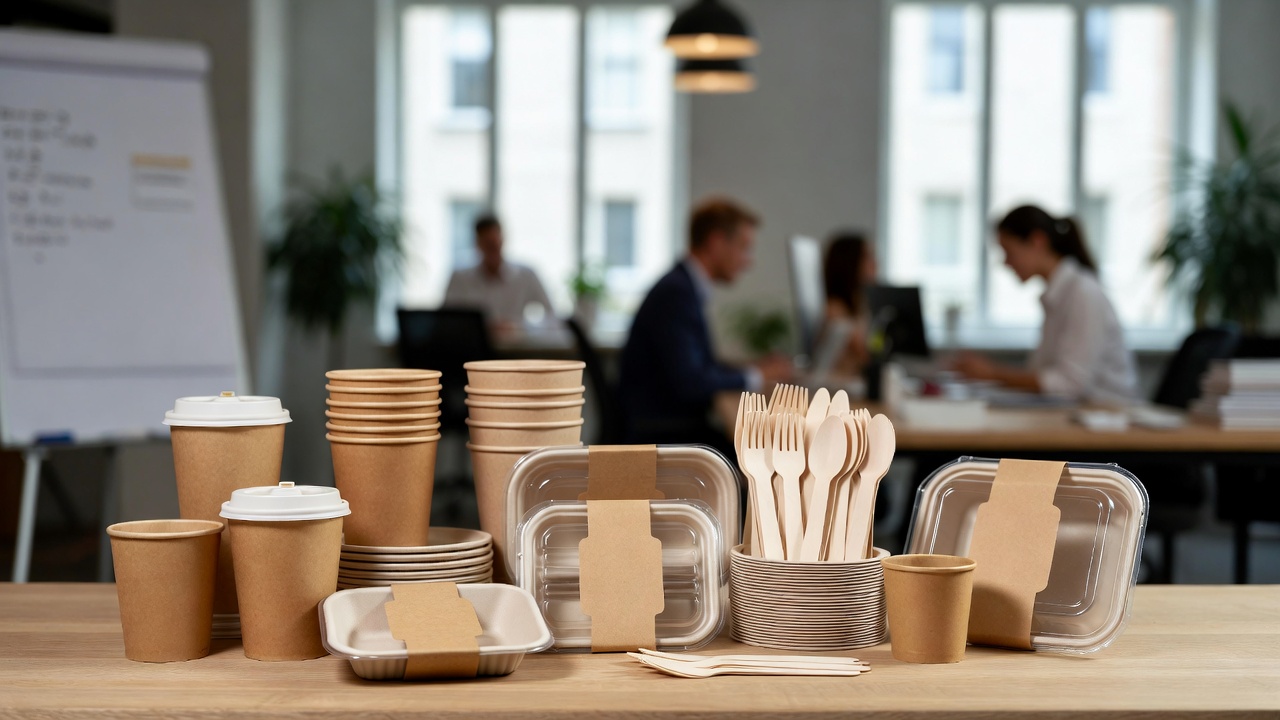

A Step-by-Step Operational Playbook for Transitioning from Conventional Plastics — Covering Audit, Material Selection, Supplier Evaluation, Cost Analysis, Compliance, Staff Training, and Customer Communication
Switching your business to compostable packaging sounds straightforward in a boardroom presentation. In practice, it is one of the most operationally complex transitions a business can undertake — touching procurement, supply chain, storage, staff training, waste infrastructure, regulatory compliance, customer communication, and financial planning simultaneously.
Most guides on this topic stop at “choose eco-friendly materials and tell your customers.” That advice is not wrong, but it is dangerously incomplete. Businesses that approach the switch without a structured plan frequently encounter the same costly pitfalls: packaging that fails in real-world conditions, composting facilities that reject their materials, cost overruns that kill internal support for the initiative, or staff and customers who do not understand how to sort and dispose of the new packaging correctly — sending expensive compostable products straight to landfill.
This guide is different. It is a complete, phased operational playbook designed for businesses that want to execute this transition successfully — whether you are a single-location restaurant, a multi-site food service operation, a retail chain, an e-commerce brand, or a municipal purchasing department. We will walk through every phase, from the initial packaging audit through full deployment, with the specific decision points, cost considerations, and compliance requirements that determine success or failure.
Phase 1: Packaging Audit — Know What You Are Replacing
Before you can switch anything, you need a precise inventory of what you are currently using. This step is skipped or done superficially by most businesses, and it is the number one reason transitions stall or go over budget.
Catalog Every Packaging Item
Create a complete list of every packaging item your business uses. For a food service operation, this typically includes takeout containers, cups (hot and cold), lids, straws, cutlery, plates, bowls, bags (shopping, produce, trash liners), napkins, food wraps, and any secondary or tertiary packaging.
For each item, document the current material (PP, PS, PET, HDPE, foam, etc.), the current unit cost, the monthly and annual volume, the supplier and lead time, the function it performs (heat resistance, moisture barrier, grease resistance, structural integrity), and where it ends up after use (landfill, recycling, litter).
Identify Your Highest-Impact Swap Targets
Not every item needs to switch at once — and not every item should. Prioritize based on three factors:
Regulatory urgency. Which items are already banned or will be banned in your market? Expanded polystyrene (EPS/foam) is banned in hundreds of cities worldwide. Single-use plastic cutlery is banned across the EU. Plastic bags face restrictions in dozens of US states. These items must switch first regardless of cost considerations.
Volume and visibility. Which items do your customers see and touch most? Takeout containers, cups, and bags are high-visibility items that directly communicate your brand values. Switching these first maximizes brand perception impact per dollar spent.
Ease of substitution. Some swaps are nearly drop-in replacements (e.g., a compostable PLA cup replacing a plastic cup of the same size). Others require operational changes (e.g., a bagasse clamshell that behaves differently from a foam container under heat). Start with easy swaps to build momentum and internal confidence.
Map Your Waste Flow
Understanding where your waste goes after it leaves your business is just as important as understanding what packaging you use. Document your current waste hauler, the disposal method for each waste stream (landfill, recycling, composting), and whether your region has commercial composting infrastructure that accepts compostable packaging.
This step is critical because compostable packaging only delivers its environmental promise if it actually reaches a composting facility. If your region has no composting infrastructure, you need to factor in the cost of either contracting a private composting hauler or accepting that, in the short term, your compostable packaging will go to landfill while you work on disposal solutions.
Phase 2: Material Selection — Matching Performance to Application
The most common failure in switching to compostable packaging is selecting materials based on environmental credentials alone, without validating that they can actually perform the job. A compostable container that leaks, warps under heat, or collapses when stacked is worse than the plastic it replaced — because it fails the customer, wastes money, and discredits the sustainability initiative internally.
Key Compostable Materials and Their Performance Profiles
Bagasse (sugarcane fiber). Made from the fibrous residue of sugarcane after juice extraction. Excellent for plates, bowls, and clamshell containers. Strong heat resistance (can handle hot and oily foods), good structural rigidity, and microwave-safe. Often the most cost-effective compostable option for food service containers — in many wholesale scenarios, bagasse has reached near price parity with conventional plastic equivalents. Limitation: not suitable for liquid-heavy applications without an additional lining.
PLA (polylactic acid). A bio-based plastic derived from fermented corn starch. Used for cold cups, clear deli containers, cutlery, and bag liners. Looks and feels like conventional plastic, making it a seamless customer experience swap. Limitation: PLA has low heat tolerance (deforms above approximately 40–45°C / 104–113°F) and is only suitable for cold applications unless specifically engineered for higher temperatures (CPLA).
CPLA (crystallized PLA). Heat-treated PLA with improved thermal resistance (up to approximately 85°C / 185°F). Used for cutlery, hot cup lids, and some hot food containers. Higher cost than standard PLA but fills the critical gap for hot food applications.
PLA/PBAT blends (compostable bio-films). Used for trash bags, produce bags, shopping bags, and flexible packaging. These blends combine PLA’s plant-based origin with PBAT’s flexibility and tear resistance. Performance has improved dramatically in recent years — modern compostable bags are approaching parity with conventional LDPE bags in many applications.
Molded fiber (wheat straw, bamboo, reed pulp). Used for plates, trays, and egg cartons. Similar performance to bagasse with different aesthetic profiles. Some molded fiber products are suitable for oven use at moderate temperatures.
Kraft paper (with compostable coatings). Used for wraps, bags, bowls, and secondary packaging. When coated with PLA or other compostable barriers (instead of PE), kraft paper containers can handle moderate moisture and grease while remaining fully compostable. Verify that the coating is certified compostable — not all “paper” packaging is compostable if it uses a PE or wax lining.
Performance Validation: Test Before You Commit
Never commit to a full-volume order based on a product specification sheet alone. Request samples from your shortlisted suppliers and test them in your actual operating conditions:
Can the container hold your hottest menu item for 30 minutes without warping or leaking? Does the cup maintain structural integrity with your hottest beverage for the duration of a typical customer experience? Does the bag hold the weight of a typical order without tearing when a customer carries it from counter to car? Can containers be stacked in your storage and prep area without collapsing? Does the packaging survive a 20-minute delivery ride in a delivery bag without becoming soggy?
Document the results. Share them with your operations team. Any item that fails real-world testing should be rejected regardless of its environmental credentials.
Phase 3: Supplier Evaluation — Beyond Price Per Unit
Choosing the right supplier is as important as choosing the right material. The compostable packaging market includes manufacturers with decades of experience and robust certification portfolios alongside opportunistic sellers making unverified claims. Due diligence here protects your business from regulatory risk, reputational damage, and product failure.
Non-Negotiable Supplier Requirements
Third-party compostability certification. Every product you purchase must carry certification from a recognized body — BPI (for North America, ASTM D6400/D6868), TUV Austria OK Compost (for Europe, EN 13432), DIN CERTCO (EN 13432), or ABA (for Australia, AS 4736/AS 5810). Do not accept self-declared “compostable” claims, manufacturer test reports without third-party verification, or certifications that cover the raw material but not the finished product. The finished product — including any coatings, inks, adhesives, and closures — must be certified.
Food safety compliance. For any food-contact packaging, require FDA compliance (for US market), LFGB certification (for EU/German market), or equivalent food-contact material certifications for your target market.
Quality management systems. ISO 9001 and ISO 14001 certifications indicate that the manufacturer operates structured quality and environmental management systems. BRCGS certification is particularly relevant for food packaging manufacturers and is recognized by major retailers worldwide.
Supply chain transparency. A credible supplier should be able to tell you where their raw materials come from, provide ISCC or FSC certification where applicable, and demonstrate ethical labor practices through Sedex or BSCI audits.
Pricing: Total Cost of Ownership, Not Just Unit Cost
The most common mistake in procurement is comparing the unit price of a compostable container directly to the unit price of a plastic container and concluding that compostable is “too expensive.”
This comparison ignores several cost factors that increasingly favor compostable packaging:
Plastic taxes and EPR fees. The UK Plastic Packaging Tax adds approximately £210.82 per metric ton to plastic packaging containing less than 30% recycled content. Similar schemes exist or are being implemented across the EU, Canada, and multiple US states. Compostable packaging is typically exempt from these levies.
Waste disposal costs. Landfill tipping fees range from $30–150 per ton depending on location and are rising. If your business can divert organic waste (including compostable packaging) to a composting stream, you may reduce overall waste disposal costs.
Regulatory compliance costs. Operating in a market that has banned specific plastic items means you must switch regardless. Businesses that switch proactively negotiate better pricing and avoid the premium that comes with last-minute, panic-driven sourcing when a ban takes effect.
Brand value and customer willingness to pay. Multiple studies indicate that 70–80% of consumers are willing to pay at least 5% more for products with sustainable packaging. For food service operations, this can translate into higher per-order revenue that more than offsets the packaging cost premium.
Operational cost of failure. If a cheaper plastic container leaks during delivery, the cost includes the refund, the replacement meal, the delivery labor, and the customer relationship damage. A compostable container that performs reliably may cost more per unit but less per successful transaction.
When all of these factors are included, the effective cost premium for compostable packaging typically shrinks from the commonly cited 15–40% raw premium to single digits — and in some product categories (notably bagasse containers at wholesale volume), compostable options have reached near price parity with plastic.
OEM and Private Label Considerations
If your business operates at sufficient volume (typically 50,000+ pieces per order), working directly with a manufacturer on OEM or private-label products can significantly reduce costs and give you control over specifications, branding, and certification. Key points to negotiate include custom sizing matched to your specific menu or product requirements, branded printing on packaging (turning your container into a marketing asset), specification control over thickness, coating, and performance characteristics, and certification support to ensure the finished custom product carries the appropriate compostability certification for your market.
Phase 4: Compliance and Certification — Getting the Legal Framework Right
Compostable packaging is one of the most heavily regulated areas of sustainability marketing. Making incorrect claims — even unintentionally — can result in fines, product recalls, and serious brand damage.
Know Your Market’s Labeling Requirements
United States: The Federal Trade Commission (FTC) Green Guides require that any product marketed as “compostable” must have competent and reliable scientific evidence that all materials in the product will break down into usable compost in a timely manner. In practice, this means ASTM D6400 or D6868 compliance with BPI certification. Several states (California, Washington, Colorado, Maryland) have enacted specific legislation with additional requirements, including mandatory third-party certification logos, specific color coding (green, brown, or beige), and the written word “compostable” on the product. Washington State goes further — it prohibits the use of the terms “biodegradable,” “degradable,” or “decomposable” entirely. The only permitted claim is “compostable.”
European Union: EN 13432 certification is legally required to market packaging as “compostable” in the EU under the Packaging and Packaging Waste Directive. The EU’s Green Claims Directive is further tightening requirements, mandating third-party verification for all environmental marketing claims. EPR (Extended Producer Responsibility) laws require producers and importers to register in each country where their product is sold, report material types and volumes, and pay license fees.
Australia: Products must be certified to AS 4736 (industrial composting) or AS 5810 (home composting) by the Australasian Bioplastics Association (ABA). Misleading environmental claims are subject to enforcement by the ACCC.
Canada: SOR/2022-138 prohibits the manufacture, import, and sale of six categories of single-use plastics. Compostable alternatives must meet applicable Canadian standards.
The PFAS Question
Per- and polyfluoroalkyl substances (PFAS) — sometimes called “forever chemicals” — have historically been used in food packaging (including some compostable products) for grease and moisture resistance. Regulatory action against PFAS in food packaging is accelerating rapidly. Multiple US states have banned PFAS in food packaging, and the EU is moving toward a broad restriction. When selecting compostable packaging, explicitly require PFAS-free products and request documentation confirming compliance. This is especially critical for molded fiber and paper-based products where PFAS coatings were historically common.
Phase 5: Infrastructure Setup — Making Composting Actually Happen
Switching your packaging materials accomplishes nothing if the waste does not reach a composting facility. This is the implementation gap where most sustainability initiatives fail.
Assess Your Local Composting Infrastructure
Contact your waste hauler and ask whether they offer commercial organics/composting collection, which compostable packaging certifications they accept (some facilities accept BPI-certified products; others do not accept any packaging), what the contamination rules are (some facilities reject loads with any non-compostable material), and what the cost difference is between composting and landfill disposal.
If your waste hauler does not offer composting, research private composting services in your area. In many markets, specialized organics haulers serve commercial food service businesses.
Set Up Internal Waste Sorting
Your facility needs clearly labeled, color-coded waste stations with separate bins for compostable waste (food scraps + compostable packaging), recycling (clean, non-compostable recyclable materials), and landfill (everything else).
Use clear signage — ideally with images showing which items go in which bin. Text-only signage fails because customers and staff frequently do not read it under time pressure.
For customer-facing businesses (restaurants, cafés, events), consider placing waste stations at exit points with staff available during peak hours to guide sorting. Studies consistently show that supervised waste stations achieve dramatically higher diversion rates than unsupervised ones.
Back-of-House Discipline
Front-of-house sorting is important, but back-of-house practices often determine whether the composting stream stays clean. Kitchen staff, dishwashers, and cleaning crews must understand which items are compostable and which are not. A single conventional plastic bag or non-compostable container in the composting bin can contaminate the load and result in it being rejected by the composting facility and diverted to landfill.
Phase 6: Staff Training — The Make-or-Break Factor
The single greatest predictor of whether a compostable packaging transition succeeds is not the material you choose or the supplier you select — it is whether your staff understands and executes the change consistently.
What Every Staff Member Must Know
Why the business is making the switch (purpose and motivation), which packaging items have changed and what they are made of, how to handle and store compostable products (cool, dry, away from heat and sunlight), which bin each waste type goes in, how to explain the change to customers when asked, and what to do if a compostable product fails (reporting process so procurement can address it).
Training Format
A single all-hands announcement is not training. Effective training includes a brief in-person session (15–20 minutes) with physical samples of the new packaging, laminated reference cards posted at waste stations and storage areas, a designated “sustainability champion” per shift who can answer questions and monitor sorting compliance, and monthly check-ins during the first 90 days to identify and correct issues.
Phase 7: Customer Communication — Turning the Switch into Brand Value
Switching to compostable packaging is an investment. Communicating it effectively to your customers converts that cost into brand equity.
Principles of Effective Communication
Be specific, not vague. “We use 100% plant-based, BPI-certified compostable containers” is credible. “We care about the environment” is empty. Customers — especially younger demographics — are increasingly sophisticated about greenwashing and will reward specificity.
Show the certification. Display the BPI, TUV, or other certification logo on your packaging and at the point of sale. This is not just good marketing — in many jurisdictions it is legally required.
Explain how to dispose. The most important piece of customer communication is not that you switched — it is what the customer should do with the packaging when they are done. “This container is compostable. Please place it in the green bin” is more valuable than a paragraph about your sustainability mission.
Acknowledge the tradeoff honestly. If the switch has resulted in a slight price increase, be transparent. “Our packaging costs a bit more because it is made from plants, not petroleum — and it composts fully within 90 days instead of sitting in a landfill for centuries. We think that’s worth it, and we hope you do too.”
Communication Channels
On-packaging messaging (printed disposal instructions and certification logos), in-store signage at waste stations and point of sale, digital channels including website, social media, email newsletter, menu notes (for food service — a simple line item such as “Served in certified compostable packaging”), and staff talking points (your team is your most powerful communication channel).
Phase 8: Monitor, Measure, and Iterate
A successful transition is not a one-time project — it is an ongoing operational process that requires monitoring and continuous improvement.
Key Metrics to Track
Diversion rate. What percentage of your total waste is going to composting vs. landfill? Track this monthly. Your waste hauler should be able to provide reports.
Contamination rate. Are your composting loads being accepted or rejected by the facility? If contamination is high, investigate the source — it is almost always a training or signage issue.
Product performance. Track any packaging failures (leaks, tears, structural collapse). If a specific product is failing in real-world conditions, work with your supplier to adjust the specification or switch products.
Cost per transaction. Monitor packaging cost as a percentage of revenue. Compare this to the pre-switch baseline, factoring in any changes in waste disposal costs, plastic taxes avoided, and revenue impact from customer perception.
Customer feedback. Pay attention to reviews, social media mentions, and direct feedback that references your packaging. Positive feedback validates the investment; negative feedback identifies performance issues that need attention.
Plan for Iteration
Your first product selection will not be perfect. Expect to refine your choices over the first 6–12 months. Some containers will need to be thicker, some will need to be swapped for a different material, and some will perform better than expected. Build supplier relationships that allow for flexibility — a manufacturer that offers samples, small trial runs, and responsive communication is worth more than one that offers the lowest price on a rigid minimum order.
Common Objections — And How to Address Them
“Compostable packaging is too expensive.” Address this with a Total Cost of Ownership analysis that includes waste disposal, plastic taxes, compliance risk, and brand value. In many scenarios, the effective premium is single digits or has reached near parity.
“We don’t have composting infrastructure.” Start by switching packaging materials now and advocating for composting infrastructure in your community. As compostable packaging adoption grows, it creates demand that drives infrastructure investment. In the interim, compostable packaging still reduces petroleum dependence and eliminates microplastic risk even in landfill.
“Our customers don’t care.” Survey data consistently shows that 70–80% of consumers prefer sustainable packaging and are willing to pay a modest premium. The customers who do not actively care are also unlikely to object. The brand risk of not switching — especially as competitors do — is significant and growing.
“Compostable products don’t perform as well.” This was true a decade ago. Modern compostable materials — particularly bagasse, advanced PLA blends, and CPLA — meet or exceed the performance of conventional alternatives in most food service applications. Test before you judge, and choose products certified to rigorous standards.
A Realistic Timeline
| Phase | Timeframe | Key Deliverable |
|---|---|---|
| Packaging Audit | Weeks 1–2 | Complete inventory with volumes, costs, and waste flow map |
| Material Selection & Sampling | Weeks 3–6 | Shortlist of products validated through real-world testing |
| Supplier Evaluation & Negotiation | Weeks 5–8 | Confirmed supplier(s) with pricing, certifications, and lead times |
| Compliance Review | Weeks 6–8 | Verified labeling and certification for target market(s) |
| Infrastructure Setup | Weeks 7–10 | Waste sorting stations installed, composting hauler contracted |
| Staff Training | Weeks 9–10 | All staff trained, reference materials in place |
| Soft Launch (Pilot) | Weeks 10–14 | Deploy in one location or one product line, gather data |
| Full Rollout | Weeks 14–20 | Expand to all locations/products based on pilot learnings |
| Ongoing Optimization | Month 6+ | Monitor metrics, refine product selection, iterate |
For a single-location business, this entire process can be compressed into 8–12 weeks. For a multi-site operation, allow 4–6 months for a phased rollout.
How Pure Compostables Supports Your Transition
At Pure Compostables, we do not just sell compostable products — we partner with businesses to make the transition work. With over 13 years of manufacturing experience, an 84,000 m² production facility, and certifications spanning ASTM D6400, EN 13432, TUV Austria OK Compost (Industrial and Home), AS 4736, AS 5810, FDA, LFGB, ISO 9001, ISO 14001, BRCGS, Sedex, and BSCI, we provide the product quality, certification depth, and supply chain reliability that a successful transition requires.
Our support includes free samples for real-world performance testing, full OEM and ODM services including custom sizing, printing, and specification, flexible order quantities from commercial case packs to full container loads, technical guidance on material selection, certification requirements, and labeling compliance, and dedicated account support from first inquiry through ongoing supply.
Whether you are switching a single product line or overhauling your entire packaging operation, we are here to make the transition as smooth and successful as possible.
Ready to start your transition? Contact our team for free samples, expert guidance, and a detailed quotation tailored to your business.
For more industry insights, visit our Blog or explore our full range of certified compostable products.
Leave a Reply